
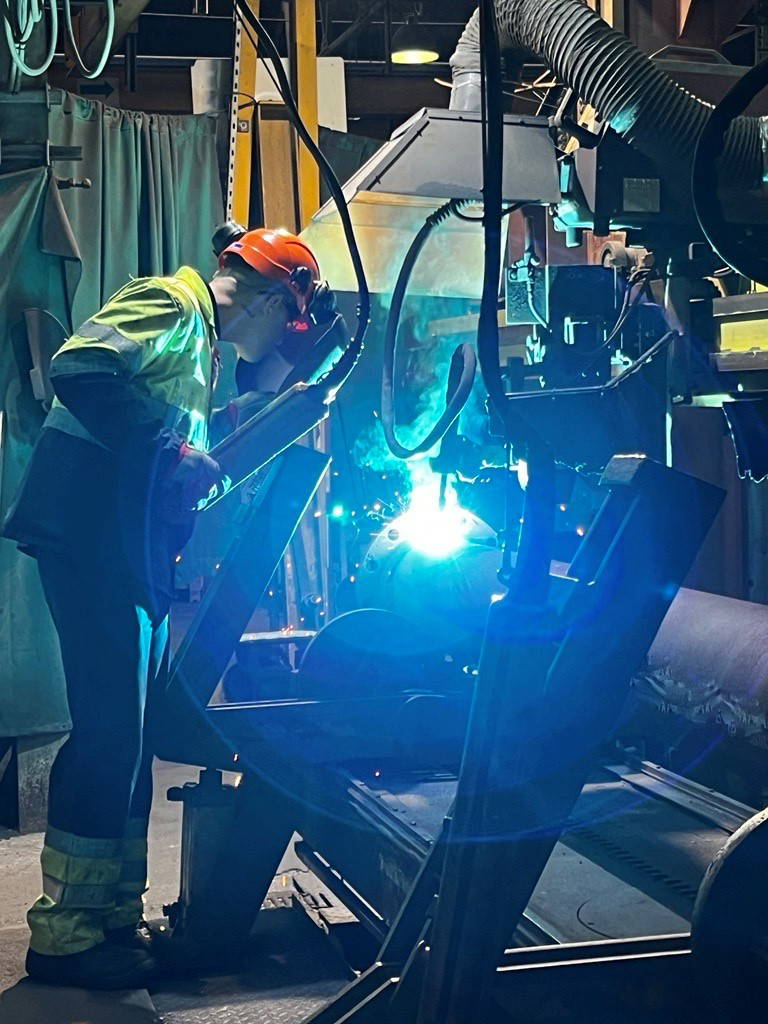
There are a number of health hazards associated with welding in particular from the following elements:
Fumes
The fume given off by welding and hot cutting processes is a varying mixture of airborne gases and very fine particles which if inhaled can cause ill health.
TIG produces the least fume although it does produce significant amounts of ozone and nitrous oxide both of which are irritant gases. MIG and MAG generally produce quite a lot more fume. MMA (stick) welding and flux cored tend to produce the most fume. If you can automate the arc welding process then submerged arc welding, ‘hot wire’ TIG or perhaps electron beam welding may be practical and cost effective.
The main health hazard with many welding operations – particularly manual metal arc (MMA) (stick) and MIG welding – is the welding fume. This consists of very fine particles of metal oxides, mainly arising from the welding rod or wire.
The composition varies depending on the metal being welded. With mild steel the fume will mainly consist of iron oxide but there is also likely to be a small percentage of manganese which is used in welding rods.
Stainless steel welding is particularly hazardous as the fume contains nickel and chromium VI oxides which are highly toxic if inhaled – both are carcinogens and can also cause occupational asthma.
Repeated exposure to low concentrations of manganese have been shown to affect the nervous system, and there are proposals to significantly reduce the Workplace Exposure Limit for manganese in 2018.
Gases
These may include ozone and, in the case of metal inert gas (MIG) and tungsten inert gas (TIG) welding, inert gases which can present a problem when working in confined spaces.
Gases that may be present in welding and cutting fume are:
- nitrous oxide (NOx),
- (Nitric oxide (NO) and Nitrogen dioxide (NO2) are often referred to collectively, in this sector of work, as Nitrous oxides. (NOx).)
- carbon dioxide (CO2),
- carbon monoxide (CO)
- shielding gas (e.g. Argon, helium) and
- ozone (O3)
Understanding welding gases
As well as the fume (which is particulate in nature), arc welders will also be exposed to gases. Ozone is produced by the action of the UV from the arc on oxygen in the air. It is highly irritant to the eyes and respiratory system.
In some cases, particularly with thicker plate, atmospheric nitrogen can be converted to highly irritant nitrogen oxides. With MIG and TIG welding, the inert gas used to stop the weld oxidising will be released. This should not present a risk when welding outdoors or in a well ventilated area, but can present a serious risk of asphyxiation in a confined space.
UV radiation from the welding arc
This can affect the eye – arc eye and skin and is also responsible for the generation of ozone from atmospheric oxygen.
Health effects
The HSE estimates that exposure to welding fume causes more than 150 deaths due to cancer every year. Exposure to the fume and gases can also cause other illnesses, including:
- Metal fume fever
- Chronic Obstructive Pulmonary Disease (COPD), which includes bronchitis and emphysema
- Asthma
- Increased susceptibility to pneumonia
Control measures
Many welders are exposed unnecessarily to welding fume. Control measures are available – but it’s important to make sure the right controls are used – there is not one solution that will be effective in all cases.
For example, local extraction systems with moveable arms are frequently used, but to be effective they need to be positioned close to and directly over the source of the fume. Other types of extraction, such as welding benches and on-gun extraction for MIG welding, are also readily available and, depending on the type of job, these are better options for many types of work.
Respiratory protection should always be the last resort, but it will be the most appropriate control measure for some types of work – particularly very large fabrications where the use of local extraction is impracticable. Powered devices which are built into the welding visor are likely to be most effective.
In order to identify appropriate measures to control the health risks involved, each specific welding activity will need a risk assessment under the Control of Substances Hazardous to Health (COSHH) regulations.
Validates Approach
Validate Consulting can assist companies aiming to comply with the Control of Substances Hazardous to Health Regulations (2002).
Our air monitoring surveys can measure personal exposure as well as background levels of hazardous dust, vapours and fumes etc.
Get in touch with Validate Consulting, on 01246 541951, or fill in our enquiry form to discuss your requirements.
We’ll then provide you with a quotation and a proposal or services. Once you’ve accepted our proposal, we then schedule the work.
Following our site visit we’ll provide a detailed report providing advice on current working practices and control measures to further reduce worker exposure as well as the appropriate use of PPE (personal protective equipment).